Breadth First Search Algorithm to Find Nearest Right Node in Bin
- 时间:2020-10-07 14:14:07
- 分类:网络文摘
- 阅读:174 次
Given the root of a binary tree and a node u in the tree, return the nearest node on the same level that is to the right of u, or return null if u is the rightmost node in its level.
Example 1:
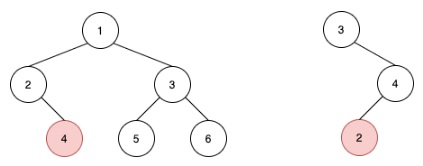
Input: root = [1,2,3,null,4,5,6], u = 4
Output: 5
Explanation: The nearest node on the same level to the right of node 4 is node 5.Example 2:
Input: root = [3,null,4,2], u = 2
Output: null
Explanation: There are no nodes to the right of 2.Example 3:
Input: root = [1], u = 1
Output: nullExample 4:
Input: root = [3,4,2,null,null,null,1], u = 4
Output: 2Constraints:
The number of nodes in the tree is in the range [1, 105].
1 <= Node.val <= 105
All values in the tree are distinct.
u is a node in the binary tree rooted at root.
Find Nearest Right Node in Binary Tree using BFS Algorithm
We know that the Breadth First Search Algorithm (BFS) traverses the tree/graph level-by-level. Thus, we know when we meet a given node – its next right neigbour on the same level. This is do-able by expanding the children nodes all at once.
At each iteration – we record the number of the nodes in the queue – which is the number of the total nodes that are all in the same level.
1 2 3 4 5 6 7 8 9 10 11 12 13 14 15 16 17 18 19 20 21 22 23 24 25 26 27 28 29 30 31 32 33 34 35 | /** * Definition for a binary tree node. * struct TreeNode { * int val; * TreeNode *left; * TreeNode *right; * TreeNode() : val(0), left(nullptr), right(nullptr) {} * TreeNode(int x) : val(x), left(nullptr), right(nullptr) {} * TreeNode(int x, TreeNode *left, TreeNode *right) : val(x), left(left), right(right) {} * }; */ class Solution { public: TreeNode* findNeartestRightNode(TreeNode* root, TreeNode* u) { if (!root) return NULL; queue<TreeNode*> Q; Q.push(root); while (!Q.empty()) { auto sz = Q.size(); for (int i = 0; i < sz; ++ i) { auto p = Q.front(); Q.pop(); if (p == u) { // given node if (i == sz - 1) { // if we don't have right node(s) return NULL; } return Q.front(); } if (p->left) Q.push(p->left); if (p->right) Q.push(p->right); } } return NULL; } }; |
/**
 * Definition for a binary tree node.
 * struct TreeNode {
 *     int val;
 *     TreeNode *left;
 *     TreeNode *right;
 *     TreeNode() : val(0), left(nullptr), right(nullptr) {}
 *     TreeNode(int x) : val(x), left(nullptr), right(nullptr) {}
 *     TreeNode(int x, TreeNode *left, TreeNode *right) : val(x), left(left), right(right) {}
 * };
 */
class Solution {
public:
    TreeNode* findNeartestRightNode(TreeNode* root, TreeNode* u) {
        if (!root) return NULL;
        queue<TreeNode*> Q;
        Q.push(root);
        while (!Q.empty()) {
            auto sz = Q.size();
            for (int i = 0; i < sz; ++ i) {
                auto p = Q.front();
                Q.pop();
                if (p == u) { // given node
                    if (i == sz - 1) { // if we don't have right node(s)
                        return NULL;
                    }
                    return Q.front();
                }
                if (p->left) Q.push(p->left);
                if (p->right) Q.push(p->right);
            }
        }
        return NULL;
    }
};The runtime complexity is O(N) where N is the number of the nodes in the binary tree and the space requirement is also O(N) as we are using a queue to perform the Breadth First Search Algorithm.
–EOF (The Ultimate Computing & Technology Blog) —
推荐阅读:Listen to what an SEO expert has to say about its benefits Depth First Search Algorithm to Compute the Smallest String Star Algorithm to Check if All Points are On the Same Line Prefix Sum Algorithm to Count Number of Nice Subarrays How to Append Another List to a Existing List in Python? (Differ Linear Algorithm to Check If All 1’s Are at Least Length K Finding the Root of a Tree (Finding the Common Destination) Does WIFI Extender Boost Wireless Signal? How to Fix Slow WIFI? Bruteforce with Memoization to Count the Square Digit Chains How to Merge Two List/Iterators in Java?
- 评论列表
-
- 添加评论