Linear Algorithm to Check If All 1’s Are at Least Length K
- 时间:2020-09-09 14:04:20
- 分类:网络文摘
- 阅读:167 次
Given an array nums of 0s and 1s and an integer k, return True if all 1’s are at least k places away from each other, otherwise return False.
Example 1:
Input: nums = [1,0,0,0,1,0,0,1], k = 2
Output: true
Explanation: Each of the 1s are at least 2 places away from each other.
Example 2:
Input: nums = [1,0,0,1,0,1], k = 2
Output: false
Explanation: The second 1 and third 1 are only one apart from each other.
Example 3:
Input: nums = [1,1,1,1,1], k = 0
Output: trueExample 4:
Input: nums = [0,1,0,1], k = 1
Output: trueConstraints:
1 <= nums.length <= 10^5
0 <= k <= nums.length
nums[i] is 0 or 1Hints:
Each time you find a number 1, check whether or not it is K or more places away from the next one. If it’s not, return false.
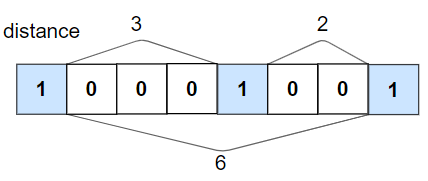
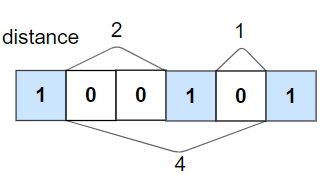
Check If All 1’s Are at Least Length K Places Away
We remember and update the last position of the 1’s if we go through the binary array one by one. And return false if we found current is one and the distance is more than K places away than the last one. If it reaches the end, then we simply return true.
The complexity is O(N) linear as we are iterating the array once.
1 2 3 4 5 6 7 8 9 10 11 12 13 14 15 | class Solution { public: bool kLengthApart(vector<int>& nums, int k) { int last = -1; for (int i = 0; i < nums.size(); ++ i) { if (nums[i] == 1) { if (last != -1) { if (i - last - 1 < k) return false; } last = i; } } return true; } }; |
class Solution {
public:
    bool kLengthApart(vector<int>& nums, int k) {
        int last = -1;
        for (int i = 0; i < nums.size(); ++ i) {
            if (nums[i] == 1) {
                if (last != -1) {
                    if (i - last - 1 < k) return false;
                }
                last = i;
            }
        }
        return true;
    }
};Note that we may not need to check if the flag is negative (which is intialised to negative one). Instead, we can initialise the last position to (-k-1).
1 2 3 4 5 6 7 8 9 10 11 12 13 | class Solution { public: bool kLengthApart(vector<int>& nums, int k) { int last = -k - 1; for (int i = 0; i < nums.size(); ++ i) { if (nums[i] == 1) { if (i - last - 1 < k) return false; last = i; } } return true; } }; |
class Solution {
public:
    bool kLengthApart(vector<int>& nums, int k) {
        int last = -k - 1;
        for (int i = 0; i < nums.size(); ++ i) {
            if (nums[i] == 1) {
                if (i - last - 1 < k) return false;
                last = i;
            }
        }
        return true;
    }
};This is a much cleaner implementation of the same algorithm.
–EOF (The Ultimate Computing & Technology Blog) —
推荐阅读:心情日记的作文 打陀螺作文400字 难忘国庆节作文500字 等底等高的圆柱与圆锥体积之和 把圆柱沿着它的直径垂直切开 现在容器内的水位至多高 求原来圆柱的体积 一个班去植树,总共植树222棵 张明一家的三个座位号分别是多少 共需油漆多少千克
- 评论列表
-
- 添加评论