Depth First Search Algorithm to Compute the Smallest String Star
- 时间:2020-09-09 13:16:32
- 分类:网络文摘
- 阅读:140 次
Given the root of a binary tree, each node has a value from 0 to 25 representing the letters ‘a’ to ‘z’: a value of 0 represents ‘a’, a value of 1 represents ‘b’, and so on.
Find the lexicographically smallest string that starts at a leaf of this tree and ends at the root.
(As a reminder, any shorter prefix of a string is lexicographically smaller: for example, “ab” is lexicographically smaller than “aba”. A leaf of a node is a node that has no children.)
Example 1:
Input: [0,1,2,3,4,3,4]
Output: “dba”
Example 2:
Input: [25,1,3,1,3,0,2]
Output: “adz”
Example 3:
Input: [2,2,1,null,1,0,null,0]
Output: “abc”
Note:
The number of nodes in the given tree will be between 1 and 8500.
Each node in the tree will have a value between 0 and 25.
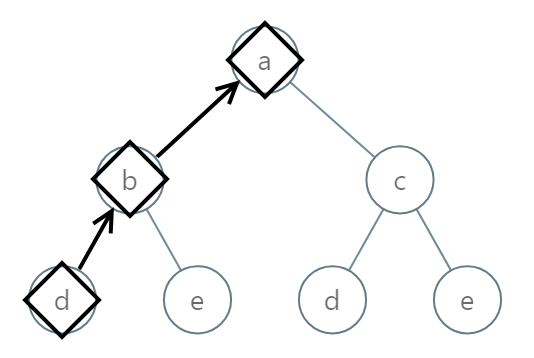
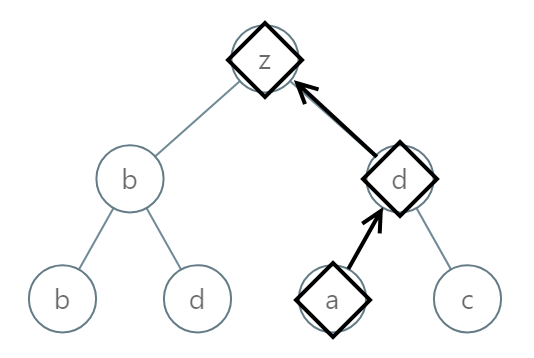
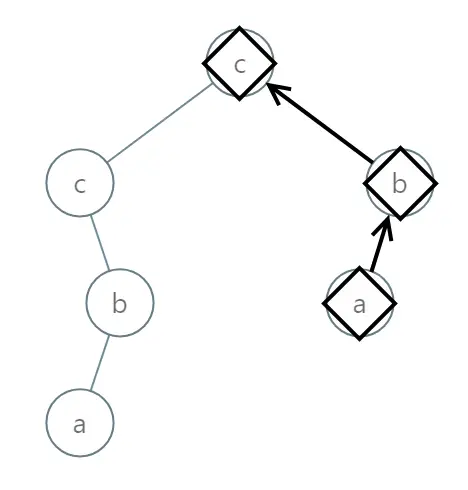
Recursive Depth First Search to Compute the Smallest String Starting From Leaf
We can start from the Root, perform a recursive DFS (Depth First Search) algorithm, and pass the string along down to the leaves. When we reach a leaf node, we construct the final string, and store the smallest one (alphabetically).
All nodes are visisted exactly once. When we finish searching the tree, we have the answer. The time complexity is O(N). In this particular case, the DFS is also the bruteforce algorithm.
1 2 3 4 5 6 7 8 9 10 11 12 13 14 15 16 17 18 19 20 21 22 23 24 25 26 27 28 29 30 31 32 | /** * Definition for a binary tree node. * struct TreeNode { * int val; * TreeNode *left; * TreeNode *right; * TreeNode() : val(0), left(nullptr), right(nullptr) {} * TreeNode(int x) : val(x), left(nullptr), right(nullptr) {} * TreeNode(int x, TreeNode *left, TreeNode *right) : val(x), left(left), right(right) {} * }; */ class Solution { public: string smallestFromLeaf(TreeNode* root) { dfs(root, ""); return ans; } private: string ans = ""; void dfs(TreeNode* root, string cur) { if (!root) return; if ((root->left == nullptr) && (root->right == nullptr)) { cur = (char)(97 + root->val) + cur; if ((ans == "") || (cur < ans)) { ans = cur; } return; } dfs(root->left, (char)(97 + root->val) + cur); dfs(root->right,(char)(97 + root->val) + cur); } }; |
/**
 * Definition for a binary tree node.
 * struct TreeNode {
 *     int val;
 *     TreeNode *left;
 *     TreeNode *right;
 *     TreeNode() : val(0), left(nullptr), right(nullptr) {}
 *     TreeNode(int x) : val(x), left(nullptr), right(nullptr) {}
 *     TreeNode(int x, TreeNode *left, TreeNode *right) : val(x), left(left), right(right) {}
 * };
 */
class Solution {
public:
    string smallestFromLeaf(TreeNode* root) {
        dfs(root, "");
        return ans;
    }
private:
    string ans = "";
    void dfs(TreeNode* root, string cur) {
        if (!root) return;
        if ((root->left == nullptr) && (root->right == nullptr)) {
            cur = (char)(97 + root->val) + cur;
            if ((ans == "") || (cur < ans)) {
               ans = cur;
            }
            return;
        }
        dfs(root->left, (char)(97 + root->val) + cur);
        dfs(root->right,(char)(97 + root->val) + cur);
    }
};Depth First Searching Algorithm using Stack
The Recursion uses implicit stacks. The compiler generates the calling stacks. The recursion code usually is more clean and concise. We can also use a stack to manually emulate the recursive calls.
1 2 3 4 5 6 7 8 9 10 11 12 13 14 15 16 17 18 19 20 21 22 23 24 25 26 27 28 29 30 31 32 33 34 35 36 37 | /** * Definition for a binary tree node. * struct TreeNode { * int val; * TreeNode *left; * TreeNode *right; * TreeNode() : val(0), left(nullptr), right(nullptr) {} * TreeNode(int x) : val(x), left(nullptr), right(nullptr) {} * TreeNode(int x, TreeNode *left, TreeNode *right) : val(x), left(left), right(right) {} * }; */ class Solution { public: string smallestFromLeaf(TreeNode* root) { if (!root) return ""; stack<pair<TreeNode*, string>> st; st.push({root, ""}); string ans = ""; while (!st.empty()) { auto p = st.top(); st.pop(); if (p.first->right) { st.push({p.first->right, (char)(97 + p.first->val) + p.second}); } if (p.first->left) { st.push({p.first->left, (char)(97 + p.first->val) + p.second}); } if ((p.first->left == nullptr) && (p.first->right == nullptr)) { string v = (char)(97 + p.first->val) + p.second; if ((ans == "") || (v < ans)) { ans = v; } } } return ans; } }; |
/**
 * Definition for a binary tree node.
 * struct TreeNode {
 *     int val;
 *     TreeNode *left;
 *     TreeNode *right;
 *     TreeNode() : val(0), left(nullptr), right(nullptr) {}
 *     TreeNode(int x) : val(x), left(nullptr), right(nullptr) {}
 *     TreeNode(int x, TreeNode *left, TreeNode *right) : val(x), left(left), right(right) {}
 * };
 */
class Solution {
public:
    string smallestFromLeaf(TreeNode* root) {
        if (!root) return "";
        stack<pair<TreeNode*, string>> st;
        st.push({root, ""});
        string ans = "";
        while (!st.empty()) {
            auto p = st.top();
            st.pop();
            if (p.first->right) {
                st.push({p.first->right, (char)(97 + p.first->val) + p.second});
            }
            if (p.first->left) {
                st.push({p.first->left, (char)(97 + p.first->val) + p.second});
            }
            if ((p.first->left == nullptr) && (p.first->right == nullptr)) {
                string v = (char)(97 + p.first->val) + p.second;
                if ((ans == "") || (v < ans)) {
                    ans = v;
                }
            }
        }
        return ans;
    }
};During the code interviews, if you are asked this question, it is better to go with the Recursion. But you can follow up with the non-recursive/iterative approach.
–EOF (The Ultimate Computing & Technology Blog) —
推荐阅读:“时刻”和“时间”有什么不同? 互质的两个数一定是质数吗? 两个质数的和为奇数,为什么必有一个为2? 第15届华杯赛决赛小学组试题解析三(A卷) 原来有多少人? 用两种思路解决一个问题 工具箱的表面积和体积如何计算? 乙将比丙领先多少米? 求两袋糖的重量之和 两家相距有多远?
- 评论列表
-
- 添加评论