How to Compute the Maximum Difference Between Node and Ancestor?
- 时间:2020-09-20 14:08:18
- 分类:网络文摘
- 阅读:136 次
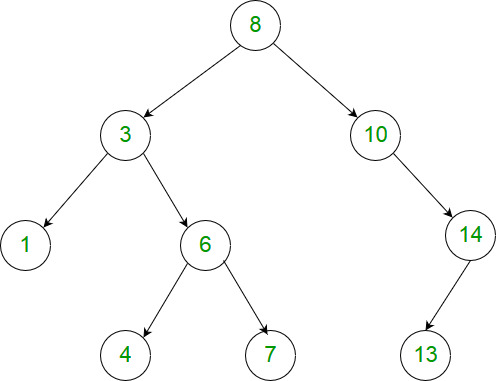
Given the root of a binary tree, find the maximum value V for which there exists different nodes A and B where V = |A.val – B.val| and A is an ancestor of B.
(A node A is an ancestor of B if either: any child of A is equal to B, or any child of A is an ancestor of B.)
Binary tree
Example 1:
Input: [8,3,10,1,6,null,14,null,null,4,7,13]
Output: 7
Explanation:
We have various ancestor-node differences, some of which are given below :
|8 – 3| = 5
|3 – 7| = 4
|8 – 1| = 7
|10 – 13| = 3
Among all possible differences, the maximum value of 7 is obtained by |8 – 1| = 7.Note:
The number of nodes in the tree is between 2 and 5000.
Each node will have value between 0 and 100000.
Depth First Search Algorithm to Find the Maximum Difference Between Node and Ancestor of a Given Binary Tree
We can utilise a helper function which pass down the min and max value for the current sub tree. Then, at any time, we can update the answer by storing the maximum of (max – min).
1 2 3 4 5 6 7 8 9 10 11 12 13 14 15 16 17 18 19 20 21 22 23 24 25 26 27 28 | /** * Definition for a binary tree node. * struct TreeNode { * int val; * TreeNode *left; * TreeNode *right; * TreeNode(int x) : val(x), left(NULL), right(NULL) {} * }; */ class Solution { public: int maxAncestorDiff(TreeNode* root) { if (root == nullptr) return 0; dfs(root, root->val, root->val); return ans; } private: int ans = 0; void dfs(TreeNode* root, int small, int big) { if (root == nullptr) return; big = max(big, root->val); small = min(small, root->val); int cur = big - small; ans = max(ans, cur); dfs(root->left, small, big); dfs(root->right, small, big); } }; |
/**
 * Definition for a binary tree node.
 * struct TreeNode {
 *     int val;
 *     TreeNode *left;
 *     TreeNode *right;
 *     TreeNode(int x) : val(x), left(NULL), right(NULL) {}
 * };
 */
class Solution {
public:
    int maxAncestorDiff(TreeNode* root) {
        if (root == nullptr) return 0;
        dfs(root, root->val, root->val);
        return ans;
    }
private:
    int ans = 0;
    void dfs(TreeNode* root, int small, int big) {
        if (root == nullptr) return;
        big = max(big, root->val);
        small = min(small, root->val);
        int cur = big - small;
        ans = max(ans, cur);
        dfs(root->left, small, big);
        dfs(root->right, small, big);
    }
};The above C++ code implements the Depth First Search Algorithm in Recursion fashion. And the answer is stored globally. It can be also passed as a reference parameter.
The algorithm runs at O(N) complexity in both time and space where N is the number of nodes in the binary tree. We can however, make the recursive DFS function return the result for the subtree, thus, making the code a little bit concise and easy to understand/follow.
1 2 3 4 5 6 7 8 9 10 11 12 13 14 15 16 17 18 19 20 21 22 23 24 | /** * Definition for a binary tree node. * struct TreeNode { * int val; * TreeNode *left; * TreeNode *right; * TreeNode(int x) : val(x), left(NULL), right(NULL) {} * }; */ class Solution { public: int maxAncestorDiff(TreeNode* root) { if (root == nullptr) return 0; return dfs(root, root->val, root->val); } private: int dfs(TreeNode* root, int small, int big) { if (root == nullptr) return big - small; big = max(big, root->val); small = min(small, root->val); return max(dfs(root->left, small, big), dfs(root->right, small, big)); } }; |
/**
 * Definition for a binary tree node.
 * struct TreeNode {
 *     int val;
 *     TreeNode *left;
 *     TreeNode *right;
 *     TreeNode(int x) : val(x), left(NULL), right(NULL) {}
 * };
 */
class Solution {
public:
    int maxAncestorDiff(TreeNode* root) {
        if (root == nullptr) return 0;
        return dfs(root, root->val, root->val);
    }
private:
    int dfs(TreeNode* root, int small, int big) {
        if (root == nullptr) return big - small;
        big = max(big, root->val);
        small = min(small, root->val);
        return max(dfs(root->left, small, big),
                   dfs(root->right, small, big));
    }
};The terminating condition for the recursive helper function is the difference value between the min and max value that is passed TOP-down from the root of the binary tree.
–EOF (The Ultimate Computing & Technology Blog) —
推荐阅读:Most Common SEO Mistakes Bloggers Make SQL Inner Join Tutorial with Example: Managers with at Least 5 D The Image Smoother Algorithm in C++/Java C++ Algorithm to Remove Outermost Parentheses How to Be Unpopular in the Coding World? How to Search in a Binary Search Tree? How to Determine Sum of Two Square Numbers? The Repeated String Match Algorithm in Javascript How to Implement the String Repeat Function in Javascript? How to Compute the Catalan Number?
- 评论列表
-
- 添加评论