Min Number of Operations to Crawler Log Folder
- 时间:2020-10-07 14:14:07
- 分类:网络文摘
- 阅读:153 次
The File system keeps a log each time some user performs a change folder operation. The operations are described below:
“../” : Move to the parent folder of the current folder. (If you are already in the main folder, remain in the same folder).
“./” : Remain in the same folder.
“x/” : Move to the child folder named x (This folder is guaranteed to always exist).You are given a list of strings logs where logs[i] is the operation performed by the user at the ith step. The file system starts in the main folder, then the operations in logs are performed.
Return the minimum number of operations needed to go back to the main folder after the change folder operations.
Example 1:
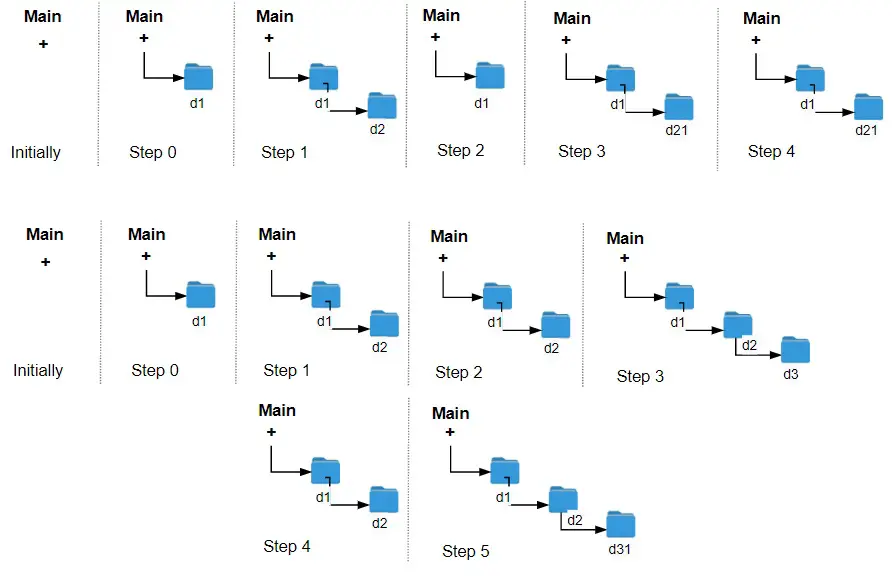
Input: logs = [“d1/”,”d2/”,”../”,”d21/”,”./”]
Output: 2
Explanation: Use this change folder operation “../” 2 times and go back to the main folder.Example 2:
Input: logs = [“d1/”,”d2/”,”./”,”d3/”,”../”,”d31/”]
Output: 3Example 3:
Input: logs = [“d1/”,”../”,”../”,”../”]
Output: 0Constraints:
1 <= logs.length < 103
2 <= logs[i].length <= 10
logs[i] contains lowercase English letters, digits, ‘.’, and ‘/’.
logs[i] follows the format described in the statement.
Folder names consist of lowercase English letters and digits.Hints:
Simulate the process but don’t move the pointer beyond the main folder.
Minimum Number of Operations to Crawl the Log Folder
The minimum operations would be to go up as many folders as we can until we reach the root. We can use a variable to remember which level of folder we are. And we can simulate the process but we need to make sure we do not move the depth above root.
1 2 3 4 5 6 7 8 9 10 11 12 | class Solution { public: int minOperations(vector<string>& logs) { int depth = 0; for (const auto &n: logs) { if (n == "../") { depth = max(0, depth - 1); } else if (n != "./") depth ++; } return depth; } }; |
class Solution {
public:
    int minOperations(vector<string>& logs) {
        int depth = 0;
        for (const auto &n: logs) {
            if (n == "../") {
                depth = max(0, depth - 1);
            } else if (n != "./") depth ++;
        }
        return depth;
    }
};The algorithm complexity is O(N). And the space requirement is O(1) constant.
–EOF (The Ultimate Computing & Technology Blog) —
推荐阅读:回归自然——小花猪2 小黑野猪——小花猪3 人猪大战——小花猪4 网站建设容易忽略的6个地方 如何检查网站是否被竞争对手Negative SEO攻击? 站长创业经验分享 屌丝站长的平凡创业路 如何做让站长赚钱更容易?做好网站浏览体验 奇妙的虹吸现象|小学作文 布达拉宫|小学作文
- 评论列表
-
- 添加评论