SQL Inner Join Tutorial with Example: Managers with at Least 5 D
- 时间:2020-10-05 13:15:44
- 分类:网络文摘
- 阅读:156 次
Given the following SQL Schema:
Create table If Not Exists Employee (Id int, Name varchar(255), Department varchar(255), ManagerId int)
Truncate table Employee
insert into Employee (Id, Name, Department, ManagerId) values ('101', 'John', 'A', 'None')
insert into Employee (Id, Name, Department, ManagerId) values ('102', 'Dan', 'A', '101')
insert into Employee (Id, Name, Department, ManagerId) values ('103', 'James', 'A', '101')
insert into Employee (Id, Name, Department, ManagerId) values ('104', 'Amy', 'A', '101')
insert into Employee (Id, Name, Department, ManagerId) values ('105', 'Anne', 'A', '101')
insert into Employee (Id, Name, Department, ManagerId) values ('106', 'Ron', 'B', '101')
The Employee table holds all employees including their managers. Every employee has an Id, and there is also a column for the manager Id.
+------+----------+-----------+----------+
|Id    |Name 	  |Department |ManagerId |
+------+----------+-----------+----------+
|101   |John 	  |A 	      |null      |
|102   |Dan 	  |A 	      |101       |
|103   |James 	  |A 	      |101       |
|104   |Amy 	  |A 	      |101       |
|105   |Anne 	  |A 	      |101       |
|106   |Ron 	  |B 	      |101       |
+------+----------+-----------+----------+
Given the Employee table, write a SQL query that finds out managers with at least 5 direct report. For the above table, your SQL query should return:
+-------+
| Name  |
+-------+
| John  |
+-------+
Note:
No one would report to himself.
How does SQL Inner-Join Work?
The SQL Inner-Join (or often referred to as Join) can be easily illustrated using the following Venn Diagram:
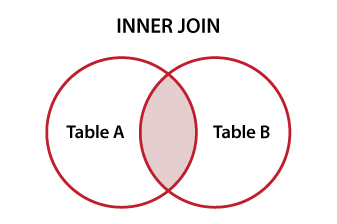
sql-joins-venn-diagrams-inner-join
Two tables are joined and the result is the intersection of two tables.
select Name from Employee as A
inner join (
    select ManagerId
    from Employee
    group by ManagerId
    having count(1) >= 5
) as B on A.ID = B.ManagerId
As we can see, two tables (queries) are joined using the keyword inner join (case insensitive) or join in short. You also need to specify the columns that connect two tables using syntax On.
SQL Sub Query
As of this problem, we can also use the sub query to solve.
select Name from
Employee where Id in (
 select ManagerId from Employee
 group by ManagerId
 having count(ManagerId) >= 5
)
This works slightly differently, the IDs from a query are returned and are used as inputs to another query (more or less like the pipe).
–EOF (The Ultimate Computing & Technology Blog) —
推荐阅读:红酒对人体有保健作用但并非人人适宜 食品安全:盘点有毒的11种常见食物 鸡蛋的蛋黄和蛋清到底哪个更有营养? 揭秘减肥食品菇类营养价值抗癌降血脂 冬季感冒多喝姜茶可治疗外感风寒感冒 消除身体疲劳可多吃七种带“香”的食物 饮食与健康:维生素B2的补充无需刻意 女性急躁易发怒可能与维生素缺乏有关系 冬天吃水果,究竟应该注意什么问题? 萝卜的保健功能和萝卜的食疗吃法
- 评论列表
-
- 添加评论