Depth First Search Algorithm to Find Leaves of a Binary Tree
- 时间:2020-09-26 22:11:41
- 分类:网络文摘
- 阅读:158 次
Given a binary tree, collect a tree’s nodes as if you were doing this: Collect and remove all leaves, repeat until the tree is empty.
Example:
Input: [1,2,3,4,5]1 / \ 2 3 / \ 4 5Output: [[4,5,3],[2],[1]]
Example of a Complete Binary Tree
Explanation:
1. Removing the leaves [4,5,3] would result in this tree:1 / 22. Now removing the leaf [2] would result in this tree:
13. Now removing the leaf [1] would result in the empty tree:
[]
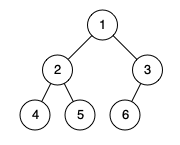
Finding the leaves is easy, but it is not trivial to remove them and iteratively finding new leaves until the tree is empty. We may however simulate the process, which takes time and this requires somehow a complex piece of implementation.
Depth First Search Algorithm to Find the Binary Tree Leaves
We define a function that recursively computes the distances/depth between any nodes to the leaf nodes. Then we can associate the nodes with its depth. This will be implemented using recursion and the following Java code demonstrates the Depth First Search.
1 2 3 4 5 6 7 8 9 10 11 12 13 14 15 16 17 18 19 20 21 22 23 24 25 26 27 | /** * Definition for a binary tree node. * public class TreeNode { * int val; * TreeNode left; * TreeNode right; * TreeNode(int x) { val = x; } * } */ class Solution { public List<List<Integer>> findLeaves(TreeNode root) { List<List<Integer>> r = new ArrayList<List<Integer>>(); dfs(root, r); return r; } private int dfs(TreeNode root, List<List<Integer>> r) { if (root == null) return 0; // leave nodes are depth 0. // the depth is the max between two branches + 1 int h = Math.max(dfs(root.left, r), dfs(root.right, r)) + 1; if (r.size() < h) { r.add(new ArrayList<Integer>()); } r.get(h - 1).add(root.val); // put the 'leave' to its level return h; } } |
/**
 * Definition for a binary tree node.
 * public class TreeNode {
 *     int val;
 *     TreeNode left;
 *     TreeNode right;
 *     TreeNode(int x) { val = x; }
 * }
 */
class Solution {
    public List<List<Integer>> findLeaves(TreeNode root) {
        List<List<Integer>> r = new ArrayList<List<Integer>>();
        dfs(root, r);
        return r;
    }

    private int dfs(TreeNode root, List<List<Integer>> r) {
        if (root == null) return 0; // leave nodes are depth 0.
        // the depth is the max between two branches + 1
        int h = Math.max(dfs(root.left, r), dfs(root.right, r)) + 1;
        if (r.size() < h) {
            r.add(new ArrayList<Integer>());
        }
        r.get(h - 1).add(root.val); // put the 'leave' to its level
        return h;
    }
}The DFS runs at O(N) time where N is the number of the nodes in the given binary tree. The space complexity is O(N) as well. The following is the C++ implementation of the same algorithm (so the time and space complexity is the same – O(N)).
1 2 3 4 5 6 7 8 9 10 11 12 13 14 15 16 17 18 19 20 21 22 23 24 25 26 27 28 29 30 31 | /** * Definition for a binary tree node. * struct TreeNode { * int val; * TreeNode *left; * TreeNode *right; * TreeNode(int x) : val(x), left(NULL), right(NULL) {} * }; */ class Solution { public: vector<vector<int>> findLeaves(TreeNode* root) { vector<vector<int>> res; dfs(root, res); return res; } int dfs(TreeNode* root, vector<vector<int>> &r) { if (root == NULL) { // leave nodes are depth 0. return 0; } int lv = dfs(root->left, r); int rv = dfs(root->right, r); int h = 1 + max(lv, rv); if (h > r.size()) { r.push_back({}); // allocate for the new level } r[h - 1].push_back(root->val); return h; } }; |
/**
 * Definition for a binary tree node.
 * struct TreeNode {
 *     int val;
 *     TreeNode *left;
 *     TreeNode *right;
 *     TreeNode(int x) : val(x), left(NULL), right(NULL) {}
 * };
 */
class Solution {
public:
    vector<vector<int>> findLeaves(TreeNode* root) {
        vector<vector<int>> res;
        dfs(root, res);
        return res;
    }

    int dfs(TreeNode* root, vector<vector<int>> &r) {
        if (root == NULL) { // leave nodes are depth 0.
            return 0;
        }
        int lv = dfs(root->left, r);
        int rv = dfs(root->right, r);
        int h = 1 + max(lv, rv);
        if (h > r.size()) {
            r.push_back({});  // allocate for the new level
        }
        r[h - 1].push_back(root->val);
        return h;
    }
};The Depth First Search Algorithm is usually implemented using Recursion where a stack will be generated and maintained by the compiler automatically. You could, however, convert the recursion into the iterative approach by manually operating the stack.
–EOF (The Ultimate Computing & Technology Blog) —
推荐阅读:南方购物频道直播_南方购物电视购物直播「高清」 广东电视台现代教育频道直播「高清」 广东经济科教频道直播_南方经济科教频道直播「高清」 大湾区卫视直播_广东南方电视台TVS2在线直播「省内版」 广东电视台影视频道直播_南方电视台影视频道TVS4直播「高清」 小学数学文化知识:认识古老的数学著作 广东电视台少儿频道直播_TVS5南方电视台少儿频道直播「高清」 小学数学文化知识:数学文化怎样走进课堂? 广州电视台综合频道直播「高清」 小学数学文化知识:数学文化有什么用?
- 评论列表
-
- 添加评论