Beginner’s Guide to the zip() function in Python3
- 时间:2020-09-21 09:15:21
- 分类:网络文摘
- 阅读:140 次
The zip function in Python 3 takes two parameters, and generate an iterator that contains tuples. Each tuple takes a value from each input – which can be tuples or arrays. It can be illustrated as follows:
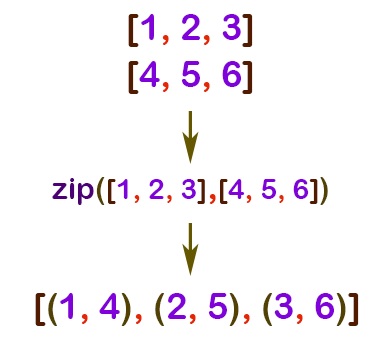
python3-zip-function
Python3 zipping two tuples
In Python2, the zip function will return all the zipped-elements in an array while in Python3, the zip function will returns an iterator – saving memory. For example,
1 2 3 4 | a = (1, 2, 3) b = (4, 5, 6) zip(a, b) # <zip object at 0x7ff81cb770c8> list(zip(a, b)) # [(1, 4), (2, 5), (3, 6)] |
a = (1, 2, 3)
b = (4, 5, 6)
zip(a, b) # <zip object at 0x7ff81cb770c8>
list(zip(a, b)) # [(1, 4), (2, 5), (3, 6)]
As you can see in this example, the source inputs can be tuples as well. You can mix-and-match and the result is always an iterator. Then you can easily convert the iterator to array using list() or to set using the set().
zipping takes minimal length
If both inputs are of different sizes, the zip function will only zip the minimal length of both. For example,
1 2 3 4 | a = (1, 2, 3, 4) b = (4, 5, 6) zip(a, b) # <zip object at 0x7abcdcb770c8> set(zip(a, b)) # {(1, 4), (2, 5), (3, 6)} |
a = (1, 2, 3, 4)
b = (4, 5, 6)
zip(a, b) # <zip object at 0x7abcdcb770c8>
set(zip(a, b)) # {(1, 4), (2, 5), (3, 6)}zip nested elements
The zip function can take nested inputs as well, for example:
1 2 3 | a=[(1,2),(3,4)] b=[(5,6),(7,8)] list(zip(a,b)) # produces [((1, 2), (5, 6)), ((3, 4), (7, 8))] |
a=[(1,2),(3,4)]
b=[(5,6),(7,8)]
list(zip(a,b)) # produces [((1, 2), (5, 6)), ((3, 4), (7, 8))]
You can use the zip() function to achieve something similar of what the enumerate() does in Python.
–EOF (The Ultimate Computing & Technology Blog) —
推荐阅读:一位个人站长的自白 2020疫情将过 个人站长能否有机会赚钱 这次疫情下对个人站长是机会吗? 站长赚钱需要做什么准备工作? 个人站长做个网站赚钱真是越来越难了 网站站长赚钱的七条经验分享 一道求比例尺的问题 欧拉的故事 分羊的故事 千里马的故事
- 评论列表
-
- 添加评论