How to Get the Maximum Level Sum of a Binary Tree using Breadth
- 时间:2020-09-20 13:49:13
- 分类:网络文摘
- 阅读:169 次
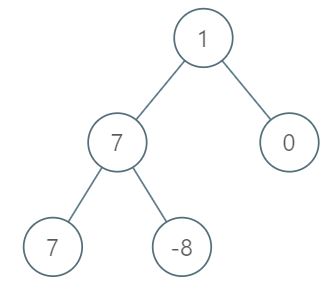
Given the root of a binary tree, the level of its root is 1, the level of its children is 2, and so on. Return the smallest level X such that the sum of all the values of nodes at level X is maximal.
Example 1:
Input: [1,7,0,7,-8,null,null]
Output: 2binary-tree
Explanation:
Level 1 sum = 1.
Level 2 sum = 7 + 0 = 7.
Level 3 sum = 7 + -8 = -1.
So we return the level with the maximum sum which is level 2.Note:
The number of nodes in the given tree is between 1 and 10^4.
-10^5 <= node.val <= 10^5
Store the Sum-Level Pairs using C++ Map
The C++ map stores the keys in the ascending order – thus we can store the sum-level pairs and return the last element of the map – which will give us the level for the maximum sum.
When we do the BFS (Breadth First Search) algorithm, we iterate all nodes in the queue – which are of same level, compute the sum, and enqueue the sum-level. If a sum has appeared before, we need to keep the minimum level.
1 2 3 4 5 6 7 8 9 10 11 12 13 14 15 16 17 18 19 20 21 22 23 24 25 26 27 28 29 30 31 32 33 34 35 36 37 38 | /** * Definition for a binary tree node. * struct TreeNode { * int val; * TreeNode *left; * TreeNode *right; * TreeNode(int x) : val(x), left(NULL), right(NULL) {} * }; */ class Solution { public: int maxLevelSum(TreeNode* root) { queue<TreeNode*> Q; if (root == nullptr) return 0; Q.push(root); int level = 0; map<int, int> sum; while (!Q.empty()) { int cursum = 0; int count = Q.size(); level ++; // expand nodes of same level for (int i = 0; i < count; ++ i) { auto p = Q.front(); cursum += p->val; if (p->left != nullptr) Q.push(p->left); if (p->right != nullptr) Q.push(p->right); Q.pop(); } if (sum.find(cursum) == sum.end()) { sum[cursum] = level; } else { sum[cursum] = min(sum[cursum], level); } } return rbegin(sum)->second; } }; |
/**
 * Definition for a binary tree node.
 * struct TreeNode {
 *     int val;
 *     TreeNode *left;
 *     TreeNode *right;
 *     TreeNode(int x) : val(x), left(NULL), right(NULL) {}
 * };
 */
class Solution {
public:
    int maxLevelSum(TreeNode* root) {
        queue<TreeNode*> Q;
        if (root == nullptr) return 0;
        Q.push(root);
        int level = 0;
        map<int, int> sum;
        while (!Q.empty()) {
            int cursum = 0;
            int count = Q.size();
            level ++;
            // expand nodes of same level
            for (int i = 0; i < count; ++ i) {
                auto p = Q.front();
                cursum += p->val;
                if (p->left != nullptr) Q.push(p->left);
                if (p->right != nullptr) Q.push(p->right);
                Q.pop();
            }
            if (sum.find(cursum) == sum.end()) {
                sum[cursum] = level;
            } else {
                sum[cursum] = min(sum[cursum], level);
            }
        }
        return rbegin(sum)->second;
    }
};The last element of a C++ std::map can get obtained via the rbegin iterator and the end is actually one element beyond the last – which may return undefined value.
The algorithmic complexity is O(NLogN) where N is the number of the binary trees – as the C++ std::map internally uses a Red/Black tree to maintain the order and it takes O(logN) to find an element.
–EOF (The Ultimate Computing & Technology Blog) —
推荐阅读:平角就是一条直线判断对错 29957四舍五入到百位、千位、万位是多少? 已知被除数,除数,商与余数的和是235,已知商是27,余数是6,求除数。 图中几条直线、几条射线、几条线段? 滞尘是什么意思? 冬冬是2008年2月29日出生的,到2016年2月29日他一共过了几个生日? 饮料架上放有大、中、小三种包装的饮料 有一架天平和一个50克的砝码,如果要得到150克糖果 看似容易-六年级易错题集锦 从前往后数小明排在第7位
- 评论列表
-
- 添加评论