Implement the Depth First Search Algorithm in Graph using Simple
- 时间:2020-09-19 10:45:07
- 分类:网络文摘
- 阅读:155 次
Given a graph represented by G(V, E) where V is the vertices and E represents the edges, we can do a Depth First Search Algorithm (DFS) on any node/vertex. The DFS will mark the current node visited and visit the node using using the (*visit) function (C++ function pointer), and recursively call itself with the connected edges.
1 2 3 4 5 6 7 8 9 10 | void traverseDepthFirstSearch(int node, void(*visit)(int)) { link t; (*visit)(k); visited[k] = 1; // mark the node as visited for (t = adj[k]; t != NULL; t = t->next) { if (!visited[t->v]) { // avoid cycle traverseDepthFirstSearch(t->v, visit); } } } |
void traverseDepthFirstSearch(int node, void(*visit)(int)) {
  link t;
  (*visit)(k);
  visited[k] = 1; // mark the node as visited
  for (t = adj[k]; t != NULL; t = t->next) {
     if (!visited[t->v]) { // avoid cycle
         traverseDepthFirstSearch(t->v, visit);
     }
  }
}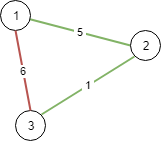
three-nodes
The algorithimic complexity is O(N) where N is the number of nodes connected to the given vertex. The space complexity is also O(N).
–EOF (The Ultimate Computing & Technology Blog) —
推荐阅读:Reconnect the Nodes in Linked List by Odd/Even in Place (Odd Eve Breadth First Search Algorithm to Find Nearest Right Node in Bin Using Priority Queue to Compute the Slow Sums using Greedy Algor Min Number of Operations to Crawler Log Folder Reclaiming the Disk Space by Deleting the Logs of the Docker Con How to Re-mount a RAID-1 Array into a RAID-0 on Linux VPS? Algorithm to Check if a Binary Tree can be Constructed via Hash Big O Simply Explained How to Rotate a Matrix (Clockwise and Anti-clockwise) in place? The Odds Are Ever in Your Favor: The Numbers Game of Earning Cli
- 评论列表
-
- 添加评论