Find the Queens That Can Attack the King
- 时间:2020-09-17 14:26:24
- 分类:网络文摘
- 阅读:157 次
On an 8×8 chessboard, there can be multiple Black Queens and one White King.
Given an array of integer coordinates queens that represents the positions of the Black Queens, and a pair of coordinates king that represent the position of the White King, return the coordinates of all the queens (in any order) that can attack the King.
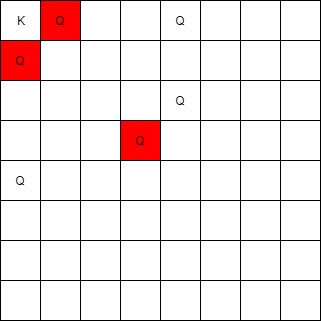
Input: queens = [[0,1],[1,0],[4,0],[0,4],[3,3],[2,4]], king = [0,0]
Output: [[0,1],[1,0],[3,3]]
Explanation:
The queen at [0,1] can attack the king cause they’re in the same row.
The queen at [1,0] can attack the king cause they’re in the same column.
The queen at [3,3] can attack the king cause they’re in the same diagnal.
The queen at [0,4] can’t attack the king cause it’s blocked by the queen at [0,1].
The queen at [4,0] can’t attack the king cause it’s blocked by the queen at [1,0].
The queen at [2,4] can’t attack the king cause it’s not in the same row/column/diagnal as the king.
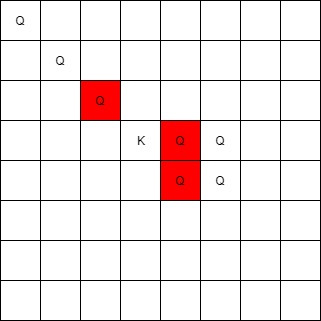
Input: queens = [[0,0],[1,1],[2,2],[3,4],[3,5],[4,4],[4,5]], king = [3,3]
Output: [[2,2],[3,4],[4,4]]
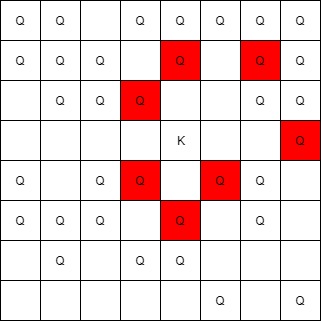
Input: queens = [[5,6],[7,7],[2,1],[0,7],[1,6],[5,1],[3,7],[0,3],[4,0],[1,2],[6,3],[5,0],[0,4],[2,2],[1,1],[6,4],[5,4],[0,0],[2,6],[4,5],[5,2],[1,4],[7,5],[2,3],[0,5],[4,2],[1,0],[2,7],[0,1],[4,6],[6,1],[0,6],[4,3],[1,7]], king = [3,4]
Output: [[2,3],[1,4],[1,6],[3,7],[4,3],[5,4],[4,5]]Hints:
Check 8 directions around the King.
Find the nearest queen in each direction.
Find the Nearest Queen in Each Direction by Bruteforce Algorithm
We can start search in 8 directions from the position of the king, until we meet the nearest the Queen or the position has fall outside of the chess board.
In order to find if there is a queen in the current position, we can preprocess the list of given queens into a hash set.
1 2 3 4 5 6 7 8 9 10 11 12 13 14 15 16 17 18 19 20 21 22 23 24 25 26 27 28 | class Solution { public: vector<vector<int>> queensAttacktheKing(vector<vector<int>>& queens, vector<int>& king) { vector<vector<int>> r; int dir[][2] = {{0, 1}, {1, 0}, {1, 1}, {-1, 0}, {-1, -1}, {0, -1}, {-1, 1}, {1, -1}}; unordered_set<string> qs; for (const auto &q: queens) { qs.insert(std::to_string(q[0]) + "," + std::to_string(q[1])); } for (int i = 0; i < 8; ++ i) { int dx = dir[i][0]; int dy = dir[i][1]; vector<int> pos(king); while ((pos[0] >= 0) && (pos[0] < 8) && (pos[1] >= 0) && (pos[1] < 8)) { pos[0] += dx; pos[1] += dy; if (qs.count( std::to_string(pos[0]) + "," + std::to_string(pos[1]))) { r.push_back(pos); break; } } } return r; } }; |
class Solution {
public:
    vector<vector<int>> queensAttacktheKing(vector<vector<int>>& queens, vector<int>& king) {
        vector<vector<int>> r;
        int dir[][2] = {{0, 1}, {1, 0}, {1, 1}, {-1, 0}, {-1, -1}, {0, -1}, {-1, 1}, {1, -1}};
        unordered_set<string> qs;
        for (const auto &q: queens) {
            qs.insert(std::to_string(q[0]) + "," + std::to_string(q[1]));
        }
        for (int i = 0; i < 8; ++ i) {
            int dx = dir[i][0];
            int dy = dir[i][1];
            vector<int> pos(king);
            while ((pos[0] >= 0) && (pos[0] < 8) &&
                (pos[1] >= 0) && (pos[1] < 8)) {
                pos[0] += dx;
                pos[1] += dy;
                if (qs.count(
                          std::to_string(pos[0]) + "," +
                          std::to_string(pos[1]))) {
                    r.push_back(pos);
                    break;
                }
            }
        }
        return r;
    }
};Alternatively, we can use O(1) memory e.g. static board boolean flags.
1 2 3 4 5 6 7 8 9 10 11 12 13 14 15 16 17 18 19 20 21 22 23 24 25 26 27 28 29 | class Solution { public: vector<vector<int>> queensAttacktheKing(vector<vector<int>>& queens, vector<int>& king) { vector<vector<int>> r; int dir[][2] = {{0, 1}, {1, 0}, {1, 1}, {-1, 0}, {-1, -1}, {0, -1}, {-1, 1}, {1, -1}}; bool board[64]; std::fill(begin(board), end(board), false); for (const auto &q: queens) { board[q[0] * 8 + q[1]] = true; } for (int i = 0; i < 8; ++ i) { int dx = dir[i][0]; int dy = dir[i][1]; vector<int> pos(king); while ((pos[0] >= 0) && (pos[0] < 8) && (pos[1] >= 0) && (pos[1] < 8)) { pos[0] += dx; pos[1] += dy; if ((pos[0] >= 0) && (pos[0] < 8) && (pos[1] >= 0) && (pos[1] < 8) && board[pos[0] * 8 + pos[1]]) { r.push_back(pos); break; } } } return r; } }; |
class Solution {
public:
    vector<vector<int>> queensAttacktheKing(vector<vector<int>>& queens, vector<int>& king) {
        vector<vector<int>> r;
        int dir[][2] = {{0, 1}, {1, 0}, {1, 1}, {-1, 0}, {-1, -1}, {0, -1}, {-1, 1}, {1, -1}};
        bool board[64];
        std::fill(begin(board), end(board), false);
        for (const auto &q: queens) {
            board[q[0] * 8 + q[1]] = true;
        }
        for (int i = 0; i < 8; ++ i) {
            int dx = dir[i][0];
            int dy = dir[i][1];
            vector<int> pos(king);
            while ((pos[0] >= 0) && (pos[0] < 8) &&
                (pos[1] >= 0) && (pos[1] < 8)) {
                pos[0] += dx;
                pos[1] += dy;
                if ((pos[0] >= 0) && (pos[0] < 8) &&
                    (pos[1] >= 0) && (pos[1] < 8) &&
                    board[pos[0] * 8 + pos[1]]) {
                    r.push_back(pos);
                    break;
                }
            }
        }
        return r;
    }
};As the board size is fixed 8×8, both the time and space complexity is O(1) constant.
–EOF (The Ultimate Computing & Technology Blog) —
推荐阅读:What Is WordPress Live Chat and How Do You Implement It? 5 Beginner’s Tips to Building a WordPress Blog 8 Best Affiliate Marketing Plugins For Your Blog How Many Squares/Rectangles Does a Rubik Cube Have? Find the 10001st Prime Number The Difference Between Sum of Squares and Square of the Sum Number of Steps to Reduce a Number in Binary Representation to O Recursive Depth First Search Algorithm to Compute the Diameter o Find the largest palindrome From the product of two 3-digit numb What is the largest prime factor of the number 600851475143 ?
- 评论列表
-
- 添加评论