Trie Class Data Structure in Python
- 时间:2020-09-09 13:16:32
- 分类:网络文摘
- 阅读:156 次
Implement a trie with insert, search, and startsWith methods.
Example:
Trie trie = new Trie(); trie.insert("apple"); trie.search("apple"); // returns true trie.search("app"); // returns false trie.startsWith("app"); // returns true trie.insert("app"); trie.search("app"); // returns trueNote:
You may assume that all inputs are consist of lowercase letters a-z.
All inputs are guaranteed to be non-empty strings.Your Trie object will be instantiated and called as such:
Implement a Trie in Python
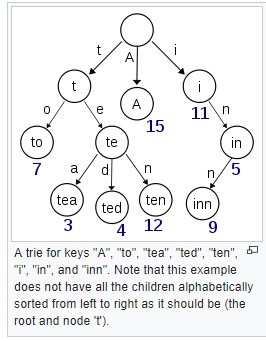
The Trie is a useful data structure that can be used to store words so that we can check if any given word (or prefix) is in the list in linear time O(N).
trie-example
It is simple to implement a Trie class in Python. For each Trie Node, we need to tell if is a leaf node (indicates a word), and the children nodes. Then we start from the begining of the word, follow the path in the Trie tree, until the end, or the corresponding child is not existent in the Trie.
The startsWith, search and insert are of similar implementations with slight difference.
1 2 3 4 5 6 7 8 9 10 11 12 13 14 15 16 17 18 19 20 21 22 23 24 25 26 27 28 29 30 31 32 33 34 35 36 37 38 39 40 41 42 43 44 45 46 47 48 49 50 | class Trie(object): def __init__(self): """ Initialize your data structure here. """ self.nodes = {} self.leaf = False def insert(self, word): """ Inserts a word into the trie. :type word: str :rtype: None """ root = self for i in word: if i in root.nodes: root = root.nodes[i] else: root.nodes[i] = Trie() root = root.nodes[i] root.leaf = True def search(self, word): """ Returns if the word is in the trie. :type word: str :rtype: bool """ root = self for i in word: if i in root.nodes: root = root.nodes[i] else: return False return root.leaf def startsWith(self, prefix): """ Returns if there is any word in the trie that starts with the given prefix. :type prefix: str :rtype: bool """ root = self for i in prefix: if i in root.nodes: root = root.nodes[i] else: return False return True |
class Trie(object):
    def __init__(self):
        """
        Initialize your data structure here.
        """
        self.nodes = {}
        self.leaf = False

    def insert(self, word):
        """
        Inserts a word into the trie.
        :type word: str
        :rtype: None
        """
        root = self
        for i in word:
            if i in root.nodes:
                root = root.nodes[i]
            else:
                root.nodes[i] = Trie()
                root = root.nodes[i]
        root.leaf = True

    def search(self, word):
        """
        Returns if the word is in the trie.
        :type word: str
        :rtype: bool
        """
        root = self
        for i in word:
            if i in root.nodes:
                root = root.nodes[i]
            else:
                return False
        return root.leaf

    def startsWith(self, prefix):
        """
        Returns if there is any word in the trie that starts with the given prefix.
        :type prefix: str
        :rtype: bool
        """
        root = self
        for i in prefix:
            if i in root.nodes:
                root = root.nodes[i]
            else:
                return False
return True The space requirement for Trie is O(NM) where N is the number of words, and M is the average length of each word. The runtime complexity for searching a word in the Trie is O(M).
The C++ Implementation of Trie can be found here: The Beginners’ Guide to Trie: How to Use the Trie in C++?
–EOF (The Ultimate Computing & Technology Blog) —
推荐阅读:营养保健:七种干果养胃补肾延寿 整治食品安全要用重典才能阻击问题食品 演艺明星代言问题食品要依法追责 危害食品安全的犯罪手段更趋隐蔽 对危害食品安全犯罪案件从严量刑 媒体评论:食品安全乱象,谁之过? 健康饮食:妙用瓜果防治夏季疾病 农夫山泉危机曝出饮用水行业乱象 消费者严重不信任国产奶粉的原因 国人消费崇洋媚外导致洋奶粉的傲慢
- 评论列表
-
- 添加评论