Algorithm to Sum The Fibonacci Numbers
- 时间:2020-09-07 12:13:31
- 分类:网络文摘
- 阅读:156 次
The Fibonacci numbers are defined as the following sequence, with the current item is the sum of the previous two items.
F(1) = 0
F(2) = 1
F(N) = F(N – 1) + F(N – 2) for N >= 3
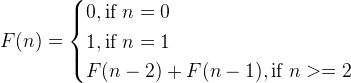
Fibonacci Equation
The first few Fibonacci numbers are: 0, 1, 1, 2, 3, 5, 8, 13, 21…
Of course, it is trivial to write a loop to sum the Fibonacci numbers of first N items.
1 2 3 4 5 6 7 8 9 10 11 12 | function sumOfFib(n) { let a = 0; let b = 1; let sum = 0; for (let i = 1; i < n; ++ i) { let c = a + b; a = b; b = c; sum += a; } return sum; } |
function sumOfFib(n) {
  let a = 0;
  let b = 1;
  let sum = 0;
  for (let i = 1; i < n; ++ i) {
     let c = a + b;
     a = b;
     b = c;
     sum += a;
  }
  return sum;
}Let’s define the S function the sum of first few Fibonacci numbers:
S(1) = F(1) = 0
S(2) = F(1) + F(2) = 1
S(3) = F(1) + F(2) + F(3) = 2
S(4) = F(1) + F(2) + F(3) + F(4) = 4
S(5) = F(1) + F(2) + F(3) + F(4) + F(5) = 7
…
We notice that

For example:
S(4) = F(6) – 1 = 5 – 1 = 4
S(3) = F(5) – 1 = 3 – 1 = 2
Using Induction to Prove the Fibonancci Sum Formula
S(1) = 0
S(2) = 1
Assume S(N) = F(N+2) – 1 stands.
S(N+1) = S(N) + F(N+1)
= F(N+2) + F(N+1) – 1
= F(N+3) – 1
And it also works for N+1!
Cancel Out the Fibonacci Numbers
We can rewrite the Fibonacci Formula as F(N) = F(N + 2) – F(N + 1).
Therefore, 
= F(2) – F(1) + F(3) – F(2) + F(4) – F(3) + …. F(N + 2) – F(N + 1)
Intermediate items are canceled out:
= F(N + 2) – F(1) = F(N + 2) – 1
How cool is that!
–EOF (The Ultimate Computing & Technology Blog) —
推荐阅读:指定 wordpress 默认用户角色后台登陆权限 为 WordPress 主题添加大红灯笼特效 为 wordpress 文章作者在评论留言时显示“本文作者”提示 为 WordPress 主题添加花瓣飘落特效 wordpress插件:WP-China-Yes 切换WP站点与官方通信至国内节点解决后台更新429错误 一段代码轻松解决wordpress定时发布失败的问题 WordPress官网打不开 出现 429 Too Many Request 的原因 下载更新wordpress程序及插件的方法 禁用wordpress4.4+版本自动生成768w像素缩略图功能 自动为wordpress文章图片添加alt属性和title属性
- 评论列表
-
- 添加评论