The Union Find (Disjoint Set) Implementation in Java/C++
- 时间:2020-09-07 12:03:44
- 分类:网络文摘
- 阅读:183 次

Java
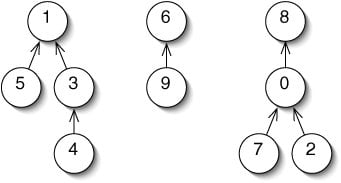
The Union-Find (Disjoint Set) is a commonly-used algorithm that can solve e.g. Minimal Spanning Tree. The following is a Java implementation of a Union-Find Class.
1 2 3 4 5 6 7 8 9 10 11 12 13 14 15 16 17 18 19 20 21 22 23 24 25 26 27 | package com.helloacm; public class UnionFind { private int[] parent; public UnionFind(int n) { parent = new int[n]; for (var i = 0; i < n; i++) { parent[i] = i; } } public int Find(int x) { if (x == parent[x]) { return x; } // compress the paths return parent[x] = Find(parent[x]); } public void Union(int x, int y) { var px = Find(x); var py = Find(y); if (px != py) { parent[px] = py; } } } |
package com.helloacm;

public class UnionFind {
    private int[] parent;
    public UnionFind(int n) {
        parent = new int[n];
        for (var i = 0; i < n; i++) {
            parent[i] = i;
        }
    }

    public int Find(int x) {
        if (x == parent[x]) {
            return x;
        }
        // compress the paths
        return parent[x] = Find(parent[x]);
    }

    public void Union(int x, int y)  {
        var px = Find(x);
        var py = Find(y);
        if (px != py) {
            parent[px] = py;
        }
    }
}The above algorithm uses O(N) space and requires O(N) time. Example usage:
1 2 3 4 5 6 7 8 9 10 | package com.helloacm; public class Main { public static void main(String[] args) { var uf = new UnionFind(5); System.out.println(uf.Find(3)); uf.Union(3, 4); System.out.println(uf.Find(3)); // after join, 3's parent is 4. } } |
package com.helloacm;

public class Main {
    public static void main(String[] args) {
        var uf = new UnionFind(5);
        System.out.println(uf.Find(3));
        uf.Union(3, 4);
        System.out.println(uf.Find(3)); // after join, 3's parent is 4.
    }
}This Java code prints 3 and 4.
C++ Disjoint Set / Union Find Algorithm Implementation
Similar, here is the C++ implementation of the Disjoint Set data structure. The union is a keyword in C++ and therefore we implement Union method instead:
1 2 3 4 5 6 7 8 9 10 11 12 13 14 15 16 17 18 19 20 21 22 23 24 | class UF { public: UF(int N) { G.resize(N); std::iota(begin(G), end(G), 0); } int Find(int x) { if (x == G[x]) { return x; } return G[x] = Find(G[x]); } void Union(int x, int y) { int px = Find(x); int py = Find(y); if (px != py) { G[px] = py; } } private: vector<int> G; }; |
class UF {
    public:
        UF(int N) {
            G.resize(N);
            std::iota(begin(G), end(G), 0);
        }

        int Find(int x) {
            if (x == G[x]) {
                return x;
            }
            return G[x] = Find(G[x]);
        }

        void Union(int x, int y) {
            int px = Find(x);
            int py = Find(y);
            if (px != py) {
                G[px] = py;
            }
        }
    private:
        vector<int> G;
};Here, we use the iota from STL to easily assign incrementing values to the initial Group vector:
1 2 | // G = {0, 1, 2, ...}; std::iota(begin(G), end(G), 0); |
// G = {0, 1, 2, ...};
std::iota(begin(G), end(G), 0);Compress Paths and Union Rules for Disjoint Set
As shown above - when in Find - we can compress the paths. Also, in the Union, we can either set G[px] = py or G[py] = px.
Choose a smaller group ID
This would be easiest - we compare the px and py value before setting the group:
1 2 3 4 5 6 7 8 | void Union(int x, int y) { int px = Find(x); int py = Find(y); if (px != py) { if (px < py) swap(px, py); // make py smaller G[px] = py; } } |
void Union(int x, int y) {
  int px = Find(x);
  int py = Find(y);
  if (px != py) {
    if (px < py) swap(px, py); // make py smaller
    G[px] = py;
  }
} Merging into Smaller Size
Alternatively, we can allocate an addition array to store the sizes for each group and always merge the larger group into the smaller one:
1 2 3 4 5 6 7 8 9 10 11 12 13 14 15 16 17 18 19 20 21 22 23 24 25 26 27 28 29 | class UF { public: UF(int N) { G.resize(N); std::iota(begin(G), end(G), 0); sizes.resize(N); std::fill(begin(sizes), end(sizes), 1); } int Find(int x) { if (x == G[x]) { return x; } return G[x] = Find(G[x]); } void Union(int x, int y) { int px = Find(x); int py = Find(y); if (px != py) { if (sizes[px] < sizes[py]) swap(px, py); G[px] = py; sizes[py] += sizes[px]; } } private: vector<int> G; vector<int> sizes; }; |
class UF {
    public:
        UF(int N) {
            G.resize(N);
            std::iota(begin(G), end(G), 0);
            sizes.resize(N);
            std::fill(begin(sizes), end(sizes), 1);
        }

        int Find(int x) {
            if (x == G[x]) {
                return x;
            }
            return G[x] = Find(G[x]);
        }

        void Union(int x, int y) {
            int px = Find(x);
            int py = Find(y);
            if (px != py) {
                if (sizes[px] < sizes[py]) swap(px, py);
                G[px] = py;
                sizes[py] += sizes[px];
            }
        }
    private:
        vector<int> G;
        vector<int> sizes;
};--EOF (The Ultimate Computing & Technology Blog) --
推荐阅读:健康瘦身:食物搭配让减肥与营养兼顾 保健养生:秋季的健康饮食的营养原则 进口食品营养标签必须符合国家规定 如何读懂包装食品营养标签核心信息 食用油的选择:解密食用油养生之道 对牙齿的健康非常有益的几种食物 常吃这些食物可让你拥有健康的牙齿 转基因食品安全立法的不足和完善建议 食品添加剂过量对人体健康带来的危害 揭秘零食里面的食品添加剂及其危害
- 评论列表
-
- 添加评论